Showing posts with label Food食べ物. Show all posts

August 18, 2010

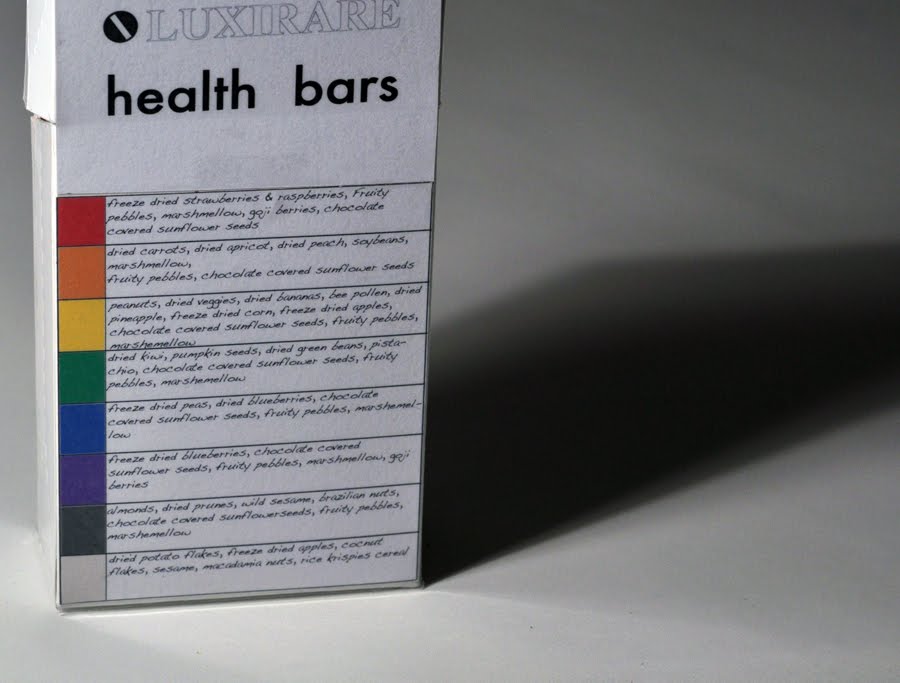
Edible Crayon「Crayon Luxirare」(食べれられるクレヨン)


{images via luxirare.com}

Yes, you are seeing it right! These are Edible Crayons! These are not the normal crayons we see everyday, but made of dried fruits and dried seeds, such as peas, green beans, dried kiwi, green fruity pebbles, dried pumpkin seeds for green crayon ingredients. Each crayon was made with color divisions. Yes the flavor is based on colors, not actual flavors...

I don't think it's on the market yet. If it was, I definitely would buy some and draw with my niece and my baby! I think I can control my urge not to eat my crayons, but I can't promise we won't lick our drawings!

June 29, 2010

One Village Coffee


{images via thedieline.com}

Check out this awesome packaging for One Village coffee, which was designed by Able! The bag was printed in white + two colors with a matte finish and gloss trapping over the logo. Because the budget didn't allow for more than one type of bag, a different label with a customized icon is used to identify each type of coffee.

I am so attracted by such design, so lovely, made me smile and I’d definitely gravitate towards this packaging would I peruse a coffee shelf in a store.

May 25, 2010

Happy Package!


It's always a happy thing to receive packages, especially from my families and friends from Japan. I just received a package from my aunt yesterday, it's full of Japanese snacks and food! I love these cute cookies made by her friend's daughter, they are so cute, so buttery and not too sweet!

May 11, 2010

Chocolate Pencils (チョコレート色鉛筆)


{images via Nendo}

I came across another beautiful chocolate today, the Chocolate Pencils.

Chocolate-pencils is a collaboration between Design Studio Nendo with patissier Tsujiguchi Hironobu (辻口博啓), the mastermind behind popular dessert shops like Mont St. Claire and Le Chocolat de H. He created a new dessert based on his impression of Nendo, and Nendo designed new tableware for the dessert.

The chocolate pencils come in a number of cocoa blends that vary in intensity, and chocophiles can use the special pencil sharpener that comes with the plate to grate chocolate onto their dessert. Pencil filings are usually the unwanted remains of sharpening a pencil, but in this case, they're the star!

Better not eat this in front of very small children so as not to confuse them!

May 7, 2010

Chocolate Pie Chart


{images via Mary & Matt's}

Made of 70% milk, 20% dark and 10% white chocolate, the Chocolate Pie Chart looks so gorgeous and yummy. If I may, I would like to make it 75% dark, 20% milk and 5% white chocolate, cause to me, white chocolate is not chocolate. But I also think it's necessary to have some on the chart so it looks pretty.... Available at Mary & Matt's General Store.

March 1, 2010

Gummy Bears (ガミーベア)


I have this horrible addiction to gummy bears. I cannot eat just one and stop. I can't eat 10 and stop. I have a ritual where I need to alternate different colored gummies--first the lighter one, then the darker colored one. There's no rhyme or reason for this insane behavior... I just do it. So on any given day when I've indulged myself into buying them...which isn't too often nowadays since they are not good for my teeth, I'll start out with the clear one, then move to the yellow, then the orange, then the red, then the green... etc. You get the point. Believe it or not, the first time I encountered these gummy bears was in a Zakka store in Japan. Why in a Zakka store? I am not so sure, I think it's because at that time only Zakka stores imported foreigh candies...? In the beginning I didn't think I would like this stuff in that they looked weird and it seemed cruel to chew on the little bears. But once I tried it, I got hooked.

Who created these tiny chewy morsels of pure sugar heaven? According to Wikipedia, the gummi bear originates from Germany where it is popular under the name
Gummibar (rubber bear) or Gummibarchen (little rubber bear). As I write this, I am chewing on Gummy Sour Worms.... This is my new addiction, and I thought I'd expand my universe....

February 8, 2010

Valentine’s Day is not for Japanese women!

{image via flickr}

{image via flickr}

{image via flickr}

{image via flickr}

{image via flickr}

{image via flickr}

{image via flickr}


{image via http://blogs.japanesepod101.com}

Before I moved to US, I didn't know that Valentine's Day is also for women too.

In the US, Valentine's Day celebrations are generally geared towards couples, with a slight bias towards women when it comes to the marketing of chocolates, flowers and other gifts---a bias that is meant to have women encourage men to buy gifts for them. In Japan, things are a little different. The Japanese celebrate St. Valentine's day in a rather unique fashion---Women give men gifts of chocolate as well as other gifts. The chocolates and other Valentine's Day items are marketed towards women, but they're marketed for them to buy and give to men, rather than the other way around.

From mid January, grocery stores, department stores, and convenience stores start selling many different kinds of domestic and imported chocolate. More than half of the chocolate sold in a year is sold around Valentine's Day in Japan. Women buy chocolate for their co-workers, bosses, male friends, brothers, father, husband, boyfriends, and so on. These gifts of chocolate are divided into two types: giri-choco (義理チョコ, obligatory chocolate) and honmei-choco (本命チョコ, chocolate for the man the woman is serious about). Giri-choco (義理チョコ) is given by women to their superiors at work as well as to other male co-workers. Many men feel embarrassed if they don't receive any chocolate on Valentine's Day. Women usually make sure to give giri-choco to men around them so that they don't feel left out. That's why it is not unusual for a woman to buy 20 to 30 boxes of this type of chocolate for distribution around the office as well as to men that she has regular contact with. The average price range for a giri-choco (義理チョコ) is from 200 yen to 500 yen each.

Women tend to give special gifts, such as neckties and clothes with an expensive box of honmei-choco (本命チョコ) to her special someone. Honmei-choco (本命チョコ) is more expensive than giri-choco and is sometimes homemade. It's considered lucky if a man could receive a honmei-choco (本命チョコ).

While all of this may seem quite one-sided, confectioners in Japan - never ones to miss an opportunity to sell more - took advantage of the Japanese feelings of obligation and created White Day in 1980 to help assuage the guilt feelings of those poor obligated males who received chocolate on Valentine's Day. On March 14th, exactly one month after Valentine's Day, men who were lucky enough to receive gifts of chocolate have the chance to return the favor by giving the women who gave them gifts of chocolate a more expensive box of chocolate or sweets (for some reason, these return gifts seem to be priced slightly higher than those the women purchase). The stores provide plenty of reminders of the approach of this day so that even the most forgetful man cannot say that it slipped his mind. The gifts of chocolate that men buy are in white boxes (after all, it is White Day) and come with separate shopping bags to put them in.

In recent years, many Japanese young women exchange chocolate gifts with their female friends. These chocolates are called tomo choko (友チョコ friend chocolate).

I am glad that I don't have to do this giri-choco (義理チョコ) thing any more. I wasn't good at it and didn't enjoy it at all. Especially I was working for a company with about 100 male co-workers! Imaging that! Of course I didn't buy Giri-choco (義理チョコ) for all of them. In fact, I ususally skipped that day....

Now I just need to get one honmei-choco (本命チョコ) for my lovely husband, and I enjoy it!

Happy Valentine’s Day, everyone!

December 30, 2009

Japanese New Year (お正月)

{鏡餅 kagami-mochi}

{門松 kado-matsu}

{お飾りokazari}

{お飾りokazari}

{ダルマ daruma}
As I’ve mentioned before, Christmas isn’t even a legal holiday in Japan, but New Year (お正月) is the biggest holiday. It can be compared to Christmas in western countries because stores and houses are decorated, families get together for a large traditional dinner, kids get gifts, cards are sent, and many shops are closed for the holiday.Usually, New Year holidays start from December 29th to January 3rd. Although nowadays most stores stay open.

There’s a lot to Japanese New Year (お正月), so I hope I can explain it clearly.

Until about two-hundred years ago, Japan followed the Chinese year with New Year in early Spring, but now follows the western calendar with New Year's Day on January 1st. But the Chinese zodiac is still used with each year being represented by an animal. There are twelve animals. 2010 is the Year Of Tiger .

In December, people start cleaning their houses from top to bottom and they may decorate their houses with traditional Japanese New Year's decorations such as 鏡餅 (kagami-mochi, which is made from two rice cakes (mochi) of different sizes, the smaller placed over the larger one, and a a Japanese type of orange placed on top.), 門松 (kado-matsu), お飾り (okazari), and ダルマ (daruma).

Also in December, people write and send out New Year's Postcards (年賀状), which are kinda similar to Christmas cards in western countries. New Year's Postcards are written by hand on special New Year's postcards that can be purchased from the post office or some other stores. Many people make their own New Year's Postcards---that's one of the reason they invented Print Gocco (プリントゴッコ). If New Year's Postcards are put in the mailbox during dates specified by the post office, they are guaranteed to be delivered on January 1st exactly.

{New Year's Postcards}
Besides, each New Year's Postcards has it’s own serial number printed on the back. In January, the post office announces a series randomly drawn numbers for a New Years Postal Lottery, whoever has a postcard with a winning number can receive a prize which is often something like a paid vacation in Hawaii, a television, a stationary set or stamps. I have never won anything yet. Not even stamps.

On New Year's Eve, people might watch one of the popular music shows on television or they may pay a visit to a temple for the temple priest’s ringing of the temple bell 108 times.

On New Year's Day, firsts are important. The first meal of the New Year should be New Year’s noodles (年越そば), many people watch the year’s first sunrise, the first dream of the year is important, as well as the first calligraphy, first tea ceremony, etc.

{Lucky Money お年玉}
Just like Christmas in the west, families get together on New Year's Day for having a traditional Japanese New Year's dinner called お節料理 (O-sechi-ryouri). Children are given gifts of money お年玉 (O-toshi-dama) in special envelopes. These envelopes are usually decorated with popular cartoon characters, so often when the kids are little, the envelopes are more appealing to them than the money inside!

Finally, on New Year's Day and for a few days following, stores often have big sales, so shopping is popular. Many stores also have Happy Bag or Lucky Bag (福袋). These are bags of various items from the store put inside a sealed bag and sold at a discount price. For example, store may put in $500 worth of products in and sale it for $100! The only catch is---you can’t look inside the bag until you pay for it! The stores tell if whether the items are for men, women or children and what the sizes are if there are clothes inside.

お正月 (New Year) is also one of the two times a year that the public is allowed inside the Imperial Palace grounds to hear the Japanese Emperor’s New Year’s greeting.

So, New Year (お正月) is a very busy time…but it’s also very fun. Hope next year I can go home and have a realy Japanese New Year (お正月) again! I really miss it!

November 6, 2009

Ukiyo-e Éclair (浮世絵エクレア)


{images via Walker Plus}

Look what I found! Éclairs from Fauchon! My friend Naoko mentioned this to me couple months ago but I didn't have chance to google it until now, and here they are! Éclair, the longish cream puff with chocolate coating is quite common in Japan, could even be bought in most convenience stores. What made these Éclairs-Éclair La Vague- special is that this time, instead of chocolate, these puffs are adorned with Hokusai's Ukiyo-e "The Great Wave off Kanagawa" (葛飾北斎の「富嶽三十六景 神奈川沖浪裏」).

Unfortunately, this "Éclair la Vague" was this summer's specialty of Fauchon, available at Takashimayas in Nihonbashi, Shinjuku, Yokohama, and JR Nagoya Takashimaya at the price of 525 yen, for the limited time until September 1st. I am 2 months late.... According to Naoko, these were not only beautiful to the eyes, but also amazingly delicious.


I also found these images from Fauchon's (Paris) last year's event. For two days, Fauchon's windows were filled with total of 45 flavors of their creations from the past five years. It must be really fun to even just look at their windows!

November 3, 2009

Origami Tea Bags (折り紙ティーパック)

{image via Popsop.com}

Here is an interesting packaging concept by the Russian designer Natalia Ponomareva. The tea bag is packed like an origami bird. It's not on the market yet. I think it will make our tea time more fun with such tea bags. My only concern is that it seems you can enjoy this beautiful tea bag only when you use glass but not tea cup nor paper cup...(I don't know how does it look like from above). And in Japanese culture, we don't make hot drinks in glasses, cause it's too hot to hold it. But I like it anyway, it adds art and fun to life!

Handmade Kinoko no yama-chocolate (手作りきのこの山)

When my parents came to visit, they brought me a lot of treasure: Print Gocco supplies, Japanese masking tape, books, foods..., and they brought me this---Handmade Kinoko no yama set (手作りきのこの山)! I mentioned this Meiji Kinoko no yama(きのこの山) a couple months ago, it's one of my favorite snacks (おやつ). I am familiar with it from childhood and I still go to buy it every week from the Japanese supermarkets in Manhattan. However this is the first one for DIY!

Instructions on the back of the box.

In the box, there are milk and white chocolate pens, chocolate mold, and stem crackers. All you have to do is to melt the chocolate ( I put the pens in warm water), put some of the chocolate into the mold, stick a cracker in and wait for half hour, then voila!! You got your own original Kinoko no yama!


They even provide you the original package so you can design your own box too!

I know it's childish, but it's a fun thing to do. I am sure it will be more fun when we have kids and do it together.